


Ambition is accelerating. Is delivery capability keeping pace?
STRATEGIC INDUSTRIES BRIEFING
Issue 01 | 28 July 2026
Across the sectors responsible for the UK’s security, resilience and economic growth, the scale of investment continues to rise.
This week’s developments point to a common challenge: turning strategic intent and capital commitments into programmes that organisations can deliver commercially.
From the Government’s £924.2 billion major project portfolio to new opportunities for defence SMEs, the repowering of Whitelee Windfarm and developments at both ends of the nuclear market, the ambition is clear.
The more difficult question is whether commercial structures, supply chains and delivery capability are developing quickly enough to support it.
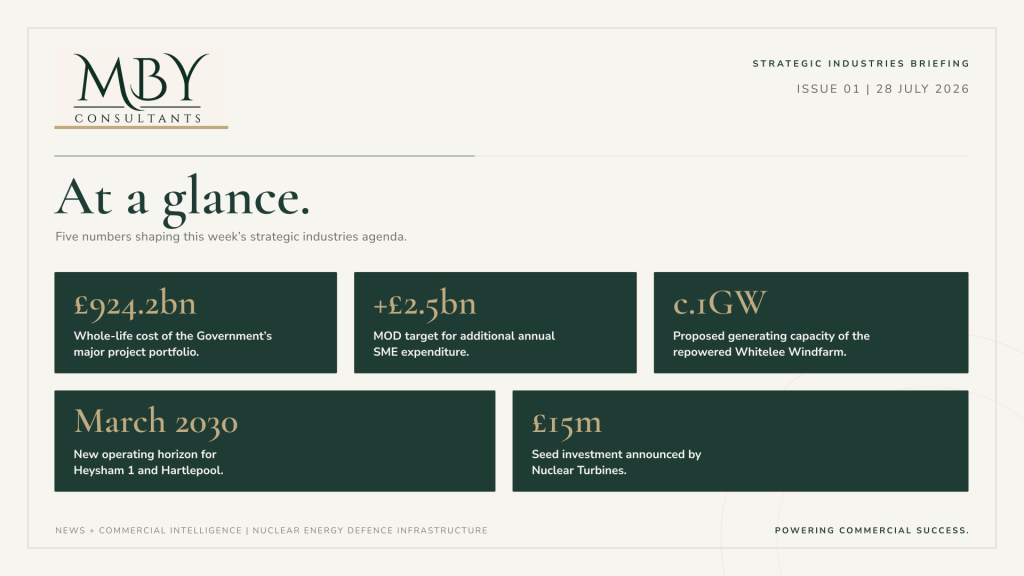
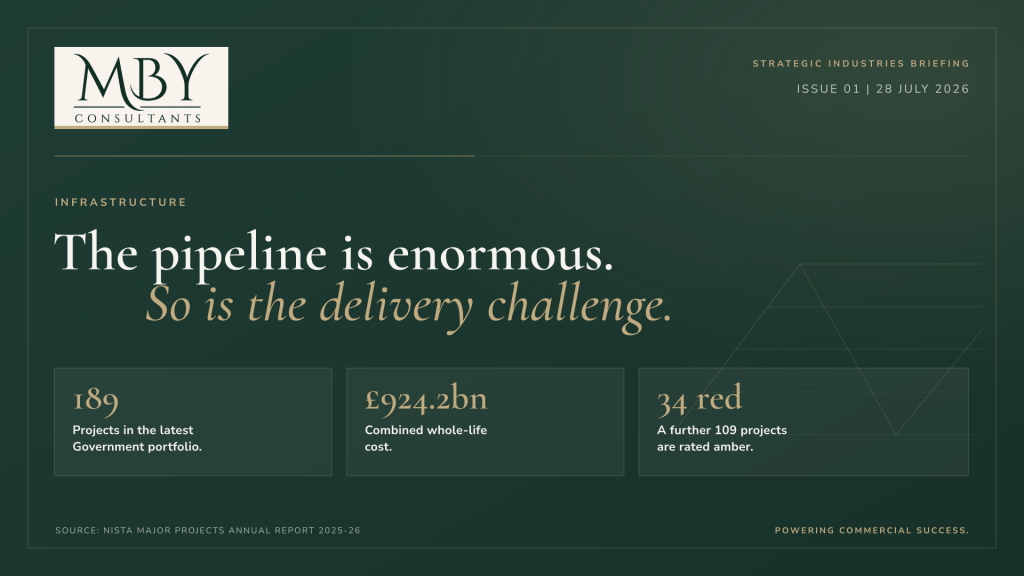
The National Infrastructure and Service Transformation Authority’s latest annual report covers 189 government projects with a combined whole-life cost of £924.2 billion. Of those projects, 34 have a red delivery rating and a further 109 are rated amber. Infrastructure and construction represent approximately £450 billion of the portfolio, while military capability accounts for £305.1 billion. Sizewell C, HS2 and the Dreadnought submarine programme are the first projects classified under the Government’s new mega-project category.
OUR VIEW
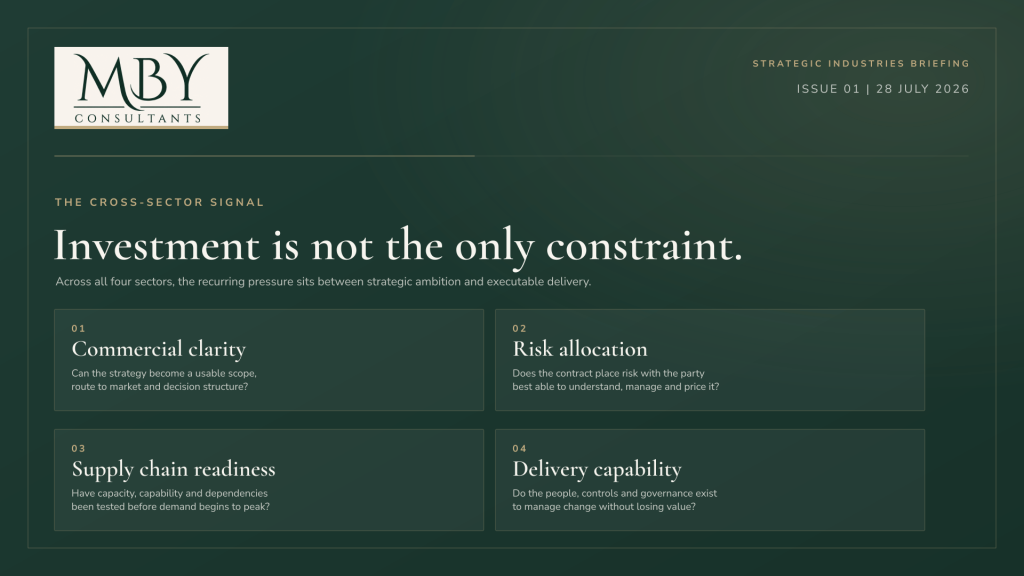
Red and amber ratings are not simply project management statistics. They frequently indicate unresolved scope, poorly allocated risk, fragile supply chain capacity and commercial arrangements that have failed to keep pace with the programme.
A major programme can have funding, political support and a technically credible objective while still lacking the commercial architecture required to deliver it.
The earlier those conditions are identified and addressed, the more value can be protected.
Source: National Infrastructure and Service Transformation Authority, Major Projects Annual Report 2025-26
https://www.gov.uk/government/publications/nista-major-projects-annual-report-2025-26/nista-major-projects-annual-report-2025-26
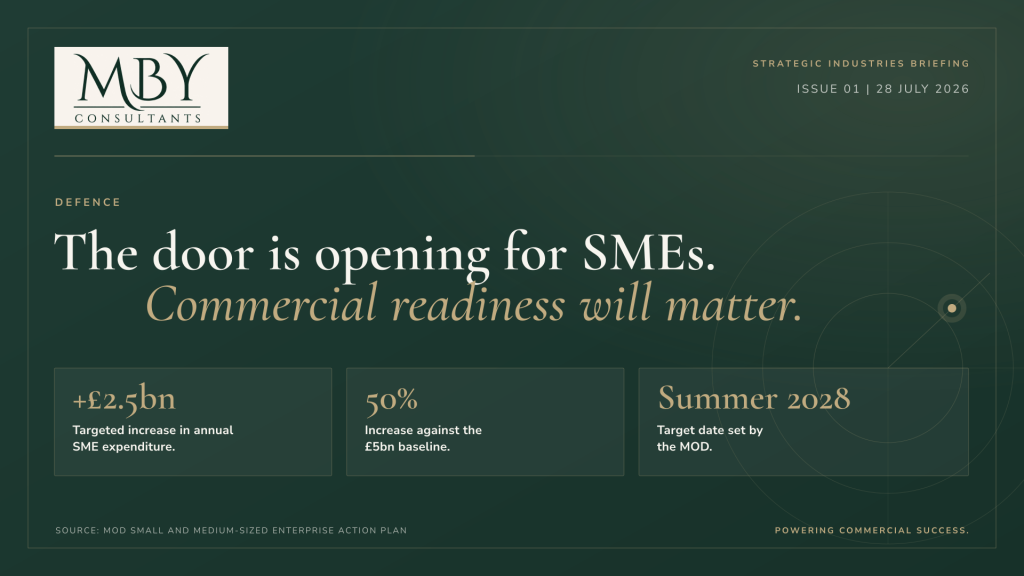
The Ministry of Defence has published a new SME Action Plan, committing to increase annual direct and indirect expenditure with smaller businesses by £2.5 billion by summer 2028.
That represents a 50 per cent increase against the current £5 billion baseline.
The plan promises simpler market entry, reduced administrative burdens, stronger prompt payment measures and clearer expectations for major defence suppliers.
Its importance lies not only in the level of expenditure, but in whether the procurement environment becomes genuinely navigable for capable smaller businesses.
OUR VIEW
Greater access does not automatically translate into sustainable growth.
SMEs will need to demonstrate commercial maturity, pricing discipline, security awareness and the ability to operate within complex prime contractor ecosystems.
They must understand the obligations they are accepting, protect themselves against disproportionate risk and ensure that their internal controls can withstand the demands of defence delivery.
Larger suppliers will also need workable mechanisms for sharing opportunity without simply transferring risk down the supply chain.
The businesses most likely to benefit will be those that prepare before the tender appears.
Source: Ministry of Defence, Small and Medium-sized Enterprise Action Plan
https://www.gov.uk/government/publications/mod-small-and-medium-sized-enterprise-sme-action-plan/ministry-of-defences-small-and-medium-sized-enterprise-sme-action-plan
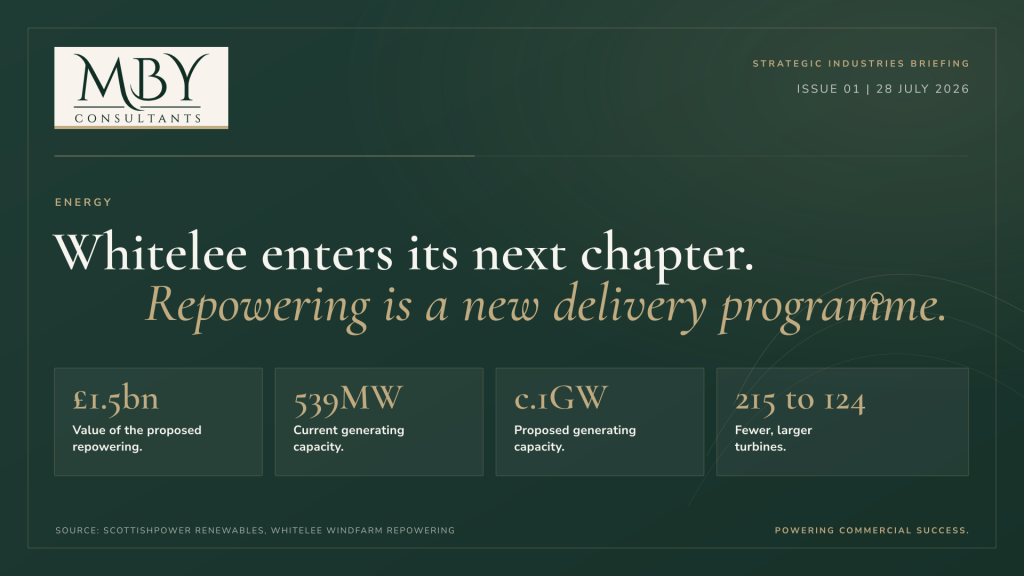
ScottishPower Renewables has announced a proposed £1.5 billion repowering of Whitelee Windfarm.
The project would replace 215 existing turbines with 124 larger machines, increasing generating capacity from 539MW to approximately 1GW.
The repowered site could generate enough electricity for around 650,000 homes. Delivery would take place in phases between 2030 and 2035, creating a substantial commercial pipeline across decommissioning, engineering, logistics, installation and grid coordination.
OUR VIEW
Repowering may sound simpler than greenfield development, but it introduces its own commercial complexity.
The programme must manage phased decommissioning, live site interfaces, logistics, grid coordination, planning obligations and existing supply chain relationships.
These activities must take place while maintaining operational continuity and coordinating a long sequence of interdependent decisions.
The commercial strategy needs to be designed around that transition. It cannot simply be treated as an extension of the original project.
Source: ScottishPower Renewables, Whitelee Windfarm repowering
https://www.scottishpowerrenewables.com/whitelee-windfarm-repowering
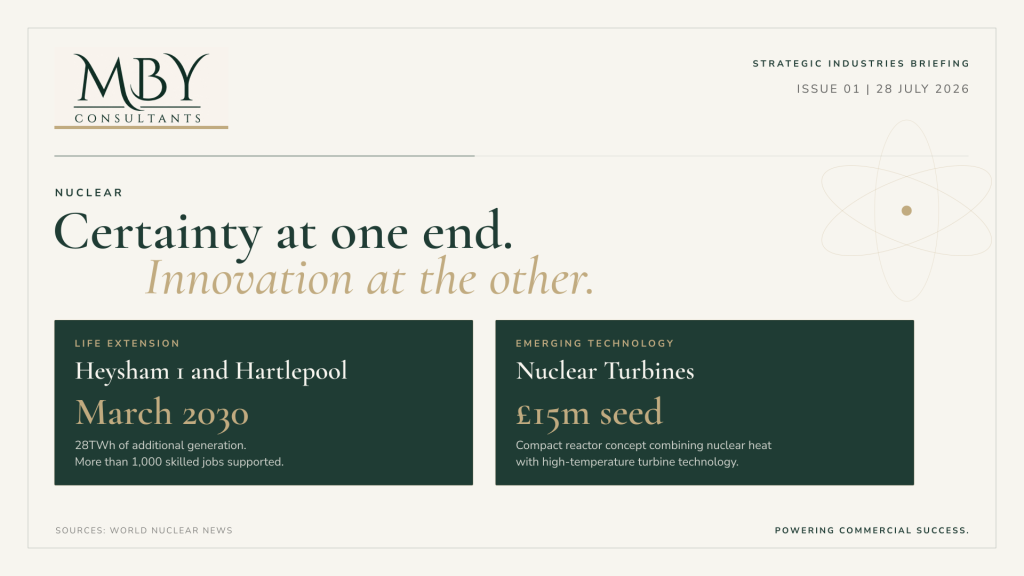
LIFE EXTENSIONS PROVIDE WELCOME CERTAINTY
EDF has confirmed that Heysham 1 and Hartlepool will continue operating until March 2030.
The additional two years are expected to produce around 28TWh of electricity while supporting more than 1,000 skilled jobs.
The decision provides greater certainty for the stations, their workforces and the specialist organisations supporting continued operation.
OUR VIEW
Operational extensions affect maintenance schedules, outage planning, specialist resource demand, component procurement and the timing of decommissioning.
Suppliers now have a clearer planning horizon, but their capacity, commercial commitments and contracts must reflect it.
Source: World Nuclear News, EDF plans further operation of Heysham 1 and Hartlepool
https://world-nuclear-news.org/articles/edf-plans-further-operation-of-uk-heysham1-and-hartlepool
NEW TECHNOLOGY CONTINUES TO ATTRACT CAPITAL
UK start-up Nuclear Turbines has announced £15 million in seed investment to develop a compact reactor concept combining nuclear heat with high-temperature turbine technology.
The business was founded by former BAE Systems engineer Jeremy Owston and Professor Tim Abram of the University of Manchester.
OUR VIEW
Innovation funding is only the opening stage.
The longer-term test is whether a novel technology can progress from an attractive technical proposition to a financeable, licensable and repeatable delivery model.
That transition requires more than engineering excellence. It requires a credible commercial model, a realistic route through regulation, a capable supply chain and clarity about how risk will be allocated as the technology develops.
Source: World Nuclear News, UK start-up Nuclear Turbines unveils novel reactor concept
https://world-nuclear-news.org/articles/uk-start-up-nuclear-turbines-unveils-novel-reactor-concept
WHAT WE ARE WATCHING NEXT
• How the Ministry of Defence converts its SME commitment into accessible commercial opportunities.
• Supplier capacity pressures across the Government’s mega-project portfolio.
• The procurement and delivery model selected for Whitelee’s repowering.
• The effect of nuclear life extensions on skills, outage planning and specialist supply chains.
• Whether emerging nuclear technologies can demonstrate a credible route to commercial deployment.
ABOUT MBY CONSULTANTS
MBY Consultants provides independent senior commercial judgement for complex programmes across energy, nuclear, defence, infrastructure and advanced industry.
We help organisations diagnose commercial exposure, focus action, embed sustainable delivery and strengthen the capability needed for growth.
Strategic Industries Briefing brings together material news from nuclear, energy, defence and infrastructure, followed by independent commercial analysis of what those developments mean for the organisations expected to deliver them.
Follow MBY Consultants on LinkedIn and subscribe to receive each new edition.
PROTECT | ADAPT | GROW