
Can strategic delivery become repeatable?
STRATEGIC INDUSTRIES BRIEFING
Issue 03 | 11 August 2026
Strategic industries do not need isolated successes. They need delivery models that can perform again, at greater scale and under different conditions. That challenge is visible across this week's developments.
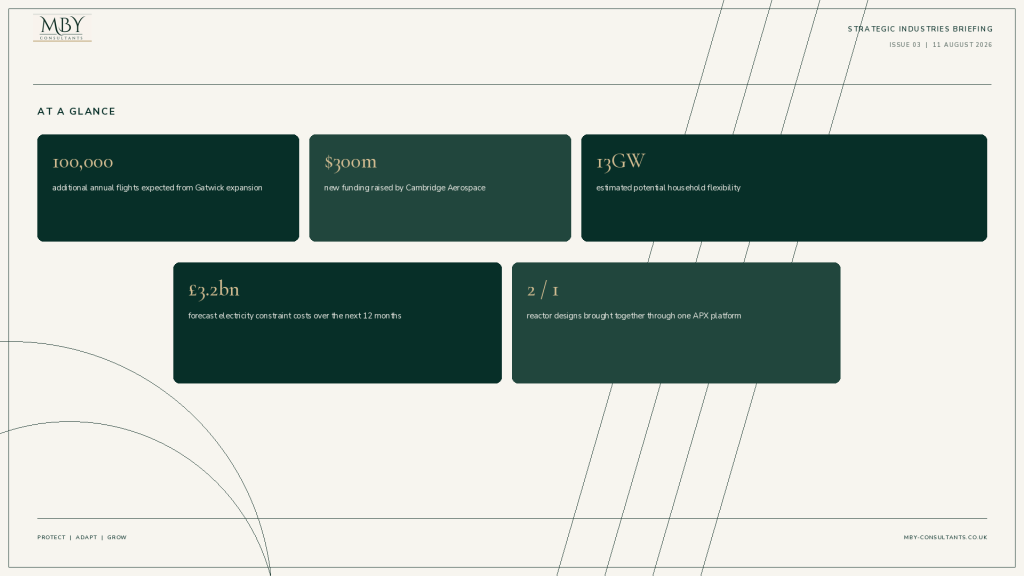
Gatwick has moved beyond a major legal obstacle, but must now convert consent into controlled execution at a live international airport. A British defence start-up has attracted another $300 million to accelerate production. The electricity system is turning consumer flexibility from a series of interventions into an enduring route to market. In nuclear, two major organisations are combining engineering, licensing and delivery capability around a platform intended for fleet deployment.
These are different sectors, technologies and commercial environments. The common question is whether success depends on exceptional effort each time, or on a system designed to repeat it.
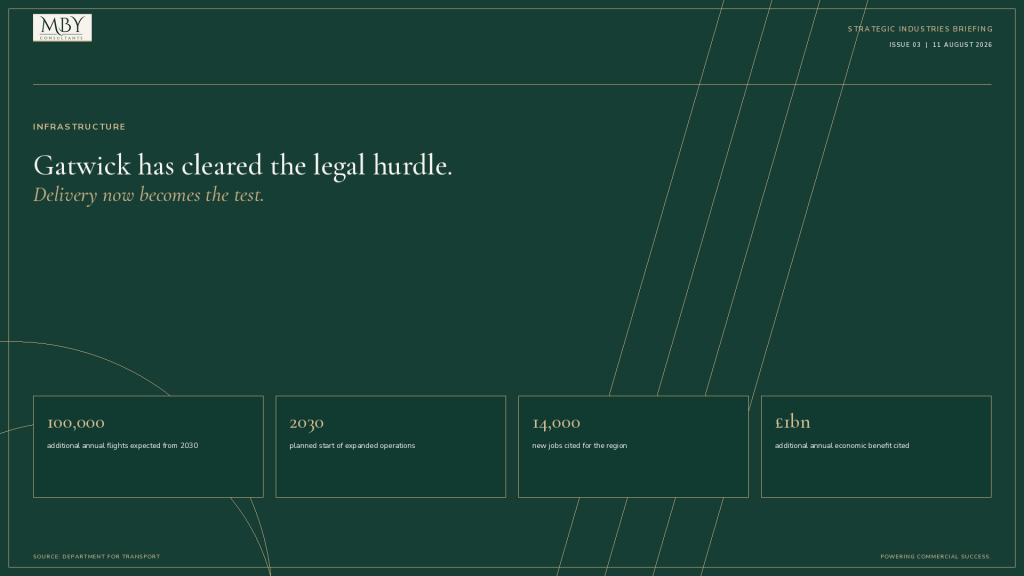
The Court of Appeal has dismissed the legal challenge against the expansion of Gatwick Airport, allowing its existing Northern Runway to be brought into routine use. The Government expects the expansion to enable up to 100,000 additional flights each year from 2030. It has also cited 14,000 new jobs and an additional £1 billion in annual economic benefits.
The decision brings a long period of legal uncertainty closer to an end. It also moves attention towards the practical work of delivering the programme while maintaining live airport operations and meeting conditions relating to air quality, carbon emissions and noise.
OUR VIEW
Legal certainty is important, but it is not delivery certainty. The programme now has to coordinate construction, operational continuity, surface access, planning obligations, environmental conditions, technology, airline requirements and a national supply chain.
The first commercial danger after a long approval process is treating the approved case as the delivery plan. It is not. The delivery baseline must translate consent into defined scope, accountable interfaces, procurement packages, decision rights and a sequence that can withstand change.
At a live airport, interfaces are not secondary details. A weakness in one package can affect safety, operations, passenger experience, cost and the wider programme. The next measure of progress should therefore be the quality of mobilisation, not the announcement that the legal hurdle has been cleared.

Cambridge Aerospace has raised $300 million in new funding at a reported valuation of $3.4 billion, only two years after the British defence technology business was founded. The investment takes the total raised by the company to more than $630 million. It will support the development and manufacture of its missile and drone interceptor systems, including the Skyhammer low-cost interceptor and the higher-speed Starhammer system. The company already holds UK Ministry of Defence contracts and plans to expand production, engineering and its industrial footprint.
OUR VIEW
A valuation measures investor expectation. It does not, by itself, prove repeatable delivery. Moving quickly from development into production places pressure on product configuration, testing, acceptance, security, export controls, manufacturing quality, supplier assurance and cash. Those demands arrive while the technology, organisation and customer requirements may still be evolving.
Defence technology companies need speed. They also need commercial and operational controls that can distinguish an authorised change from uncontrolled variation, a production target from evidenced output and an attractive order book from sustainable value. The opportunity is significant. So is the risk of allowing urgency to become the operating model.
For government and prime contractors, the question is how procurement, assurance and acceptance can move quickly enough to support innovation without weakening confidence in performance. For fast-growing suppliers, the challenge is to build discipline early enough that growth strengthens the business rather than exposing it.
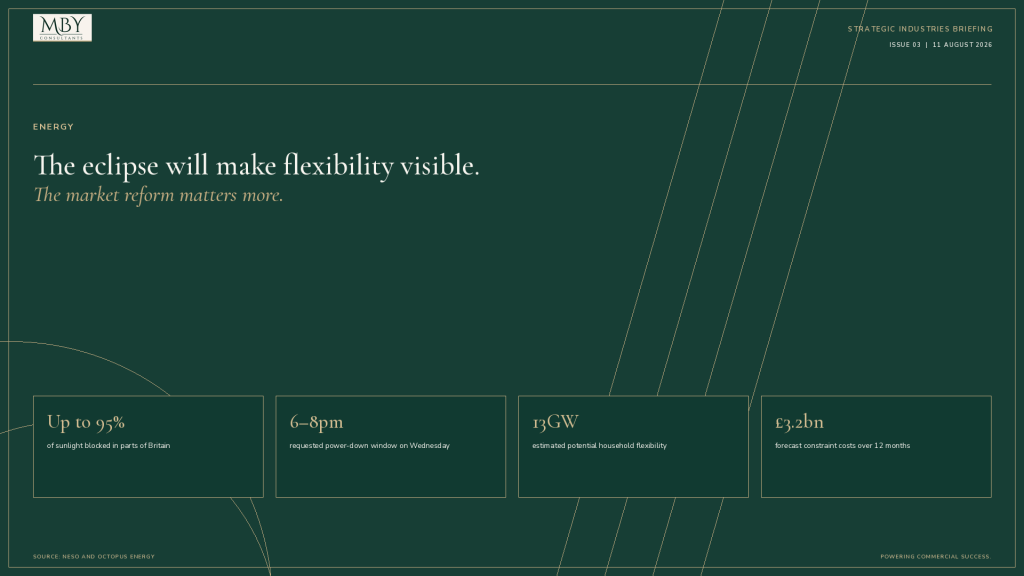
Wednesday's solar eclipse is expected to block up to 95 per cent of sunlight in parts of Britain, briefly reducing solar generation as evening electricity demand rises. Octopus Energy is asking participating customers to reduce consumption between 6pm and 8pm. The company estimates that households could eventually provide up to 13GW of flexible capacity through changes in demand, smart appliances, electric vehicles and home batteries.
The event comes as the National Energy System Operator prepares to expand its Demand Flexibility Service and progressively bring the Local Constraints Market into a single national service. NESO says the change will create a clearer route to market for consumer-led flexibility. It forecasts electricity constraint costs of £3.2 billion over the next 12 months and identifies £23.3 million of potential flexibility opportunity between April and July 2026 alone, significantly more than the volume contracted.
OUR VIEW
A two-hour public response to an eclipse is a useful demonstration. An enduring flexibility market is a much more demanding commercial system.
Participants need clear baselines, dispatch instructions, measurement, settlement and confidence that performance will be recognised consistently. Aggregators and technology providers need routes to market that justify investment. NESO needs dependable information and sufficient participation to treat flexibility as an operational resource.
Consolidating services can reduce friction, but only if the new framework is easier to understand, commercially predictable and capable of verifying delivery close to real time. The value lies in moving flexibility from occasional intervention to repeatable system capability. That transition will depend as much on market design, data and contractual clarity as it does on smart technology.
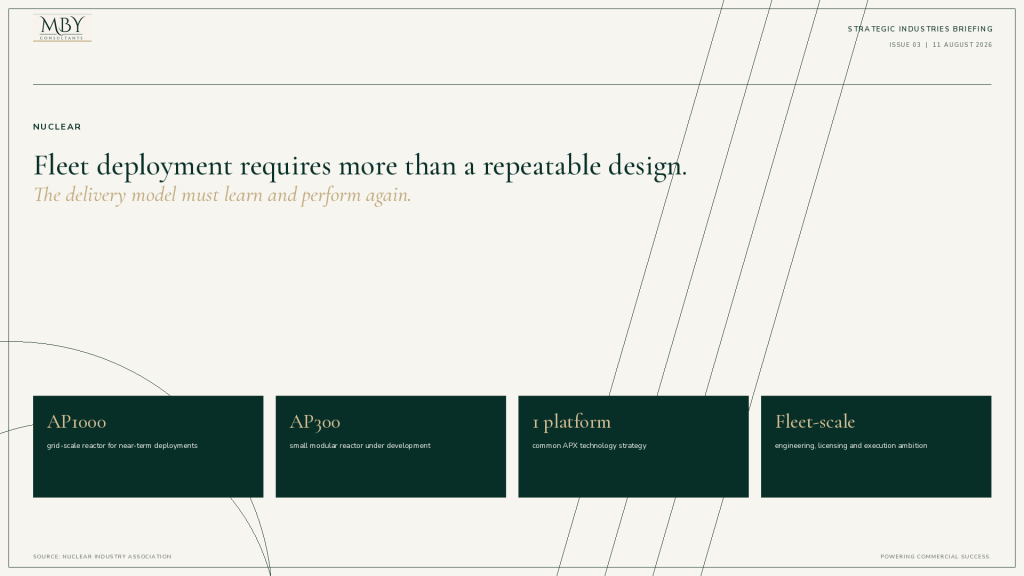
Westinghouse and Amentum have entered into a series of agreements to support Westinghouse's APX technology platform. The collaboration is intended to strengthen engineering and execution for fleet-scale deployment of the AP1000 reactor while advancing the AP300 small modular reactor. The companies will also work together towards US Nuclear Regulatory Commission approval for the AP300. The wider APX strategy seeks to use common engineering, components, licensing approaches, fuel design and supply-chain arrangements across both reactor designs.
OUR VIEW
The commercial case for a fleet rests on learning once and applying that learning repeatedly. That does not happen automatically because two projects use the same technology. Repeatability requires a stable reference design, disciplined configuration control, qualified suppliers, defined limits for local adaptation and a mechanism for operational and regulatory learning to return to the core programme.
The same principle applies commercially. Contract structures, risk allocation, assurance requirements and performance information must support standardisation rather than recreate a bespoke delivery environment for every project.
Local conditions will always require variation. The important distinction is between variation that is deliberate, controlled and valuable, and variation introduced because the delivery system has failed to retain its own learning.
Fleet delivery is not the repeated construction of an asset. It is the repeated performance of an entire delivery model.
One successful project can depend on extraordinary effort, favourable conditions or a small number of experienced people holding the system together.
Strategic industries cannot rely on that model. Scale magnifies the strengths of a delivery system, but it also magnifies weak interfaces, inconsistent decisions, fragmented information and commercial arrangements that depend on improvisation.
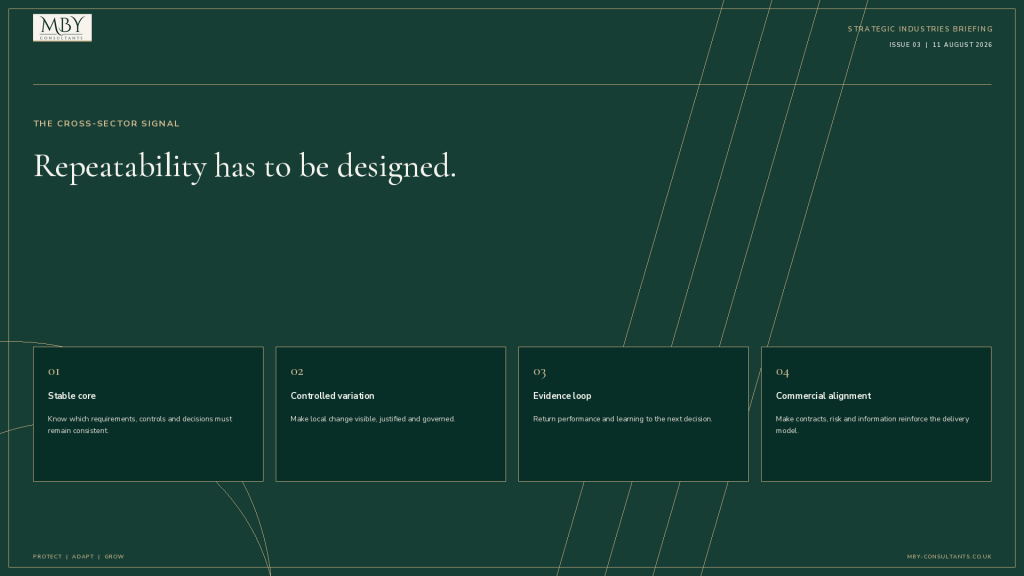
Four conditions make delivery repeatable:
- A stable core
The organisation knows which requirements, controls and design decisions must remain consistent.
- Controlled variation
Local changes are visible, justified and governed without destabilising the whole model.
- An evidence loop
Performance, failure and learning return to the people responsible for the next decision.
- Commercial alignment
Contracts, incentives, risk and information reinforce the intended delivery model across organisational boundaries.
Without those conditions, expansion creates more activity but not necessarily more control.
The strategic question is not simply whether an organisation can deliver once. It is whether the first success makes the second delivery stronger.
WHAT WE ARE WATCHING NEXT
- How Gatwick converts the approved case into procurement, mobilisation and an integrated delivery baseline.
- Whether Cambridge Aerospace can translate exceptional investment momentum into repeatable manufacturing and accepted operational performance.
- Participation and system performance during Wednesday's eclipse response.
- How NESO defines measurement, settlement and access as consumer flexibility becomes an enduring national market.
- How the APX partnership governs standardisation, local adaptation and supply-chain learning across future deployments.
ABOUT MBY CONSULTANTS
MBY Consultants provides independent senior commercial judgement for complex programmes across energy, nuclear, defence, infrastructure and advanced industry.
We help organisations diagnose commercial exposure, focus action, embed sustainable delivery and strengthen the capability needed for growth.
PROTECT | ADAPT | GROW