

Can the UK secure the capacity its ambitions now demand?
STRATEGIC INDUSTRIES BRIEFING
Issue 02 | 4 August 2026
REMEMBERING SIR IAN WOOD
Before turning to this week's developments, we want to acknowledge the passing of Sir Ian Wood, one of the defining figures in the history of the North Sea and modern Aberdeen.
His leadership helped transform a family business into a global energy services company and establish the North East of Scotland as a centre of engineering and commercial expertise. His influence extended far beyond Wood Group. Through the independent Wood Review, his work on regional economic development and his philanthropy, he continued to invest in the future of the region and its people.
This briefing is concerned with the capabilities and institutions that allow strategic industries to endure. Sir Ian's life is a reminder that those capabilities are built by people with the vision to see opportunity early and the persistence to turn it into lasting value.
MBY Consultants extends its sincere condolences to Lady Helen, his family, friends, former colleagues and all those whose lives he touched.
Read Offshore Energies UK's tribute to Sir Ian Wood

Last week, we asked whether delivery capability was keeping pace with ambition.
This week, the question has become more specific: where will the required capacity come from, and who is proving that it exists?
Capacity in strategic industries is not a single thing. It includes physical infrastructure, network access, specialist materials, skilled people, supply-chain resilience and the organisational systems needed to coordinate them.
Five developments this week show what happens when that capacity is stretched, transferred, rationed or deliberately built.
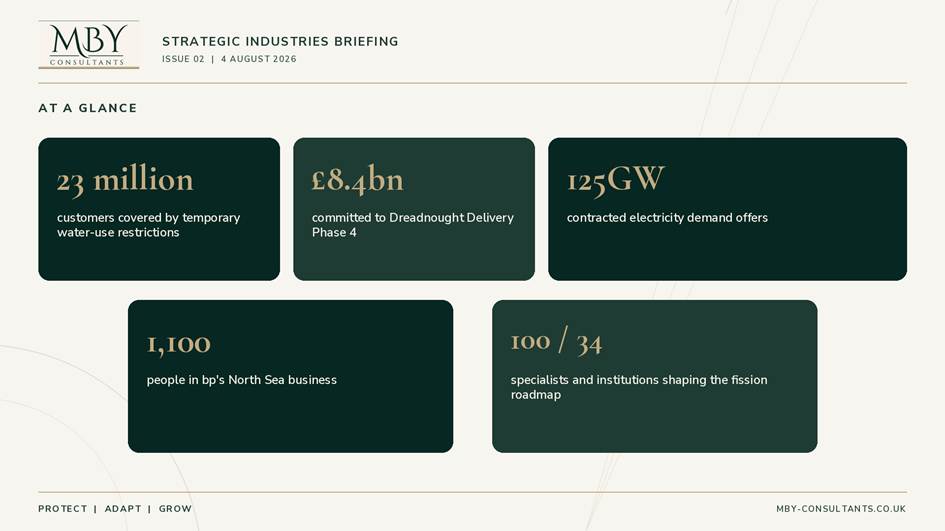
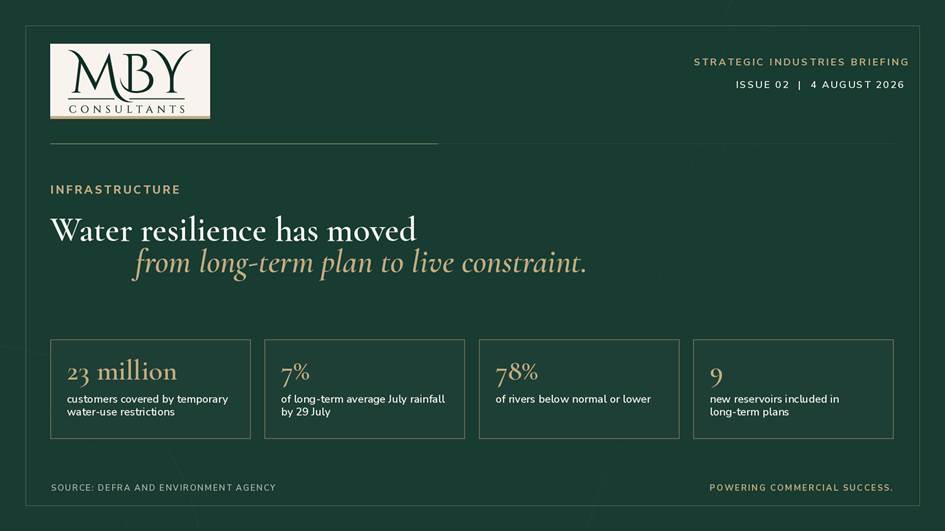
Half of England is now officially in drought following exceptionally low rainfall and sustained high temperatures. By 29 July, rainfall across England had reached only 7 per cent of its long-term average for the month. Some 78 per cent of rivers were classified as below normal or lower, while seven water companies had introduced temporary use bans affecting 23 million customers. The Government has pointed to long-term investment, including nine planned reservoirs, while calling on water companies to accelerate leakage reduction and protect continuity of supply.
OUR VIEW
Drought is the operational consequence of a system whose physical, regulatory and commercial decisions have to work together. Nine new reservoirs matter, so do the programmes connecting them to demand forecasts, planning consents, funding models, environmental obligations, leakage reduction and existing networks.
Resilience will not be created by capital investment alone. It depends on whether those interfaces are governed as one system, with clear accountability for decisions and dependencies that cross organisational boundaries. The test is not whether a long-term plan exists. It is whether today's operating pressures are changing the priorities, sequencing and pace of delivery.
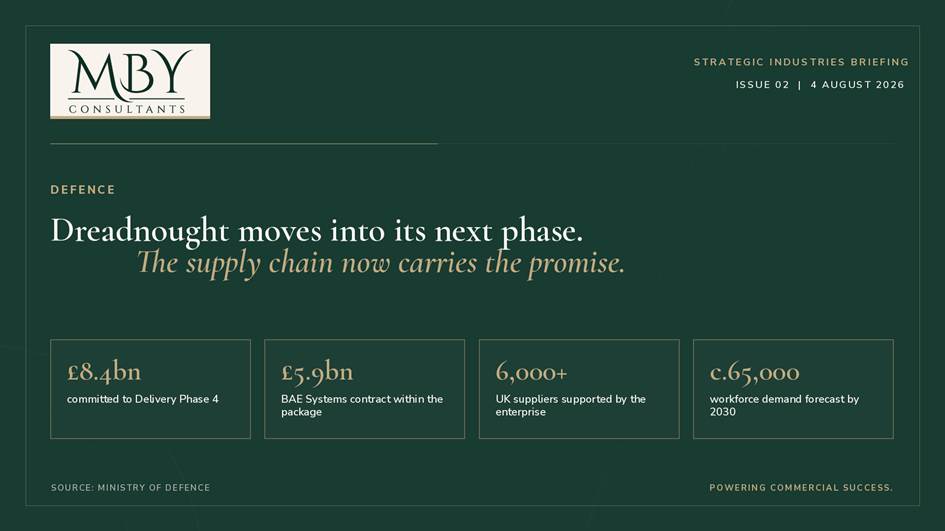
The Government has committed £8.4 billion to Delivery Phase 4 of the Dreadnought Class submarine programme. The package includes a £5.9 billion contract with BAE Systems, with further investment directed to Rolls-Royce Submarines and the wider UK supply chain. The Defence Nuclear Enterprise currently supports around 47,000 jobs and more than 6,000 UK suppliers. Workforce demand is forecast to reach approximately 65,000 by 2030.
The BAE Systems contract will use recent changes to the Single Source Contract Regulations to link incentives to agreed performance targets, productivity, cost control and programme outcomes.
OUR VIEW
This is not only a funding announcement. It is a long-term test of industrial capacity and commercial alignment. Performance incentives can support better delivery, but only when targets, baselines, information, dependencies and decision rights are coherent. If one part of that system is weak, pressure will move through the supply chain rather than disappear.
For smaller suppliers, a long-term programme is not automatically safe revenue. Growth can expose working capital, recruitment, customer concentration, delivery controls and the ability to manage change.
Prime contractors need confidence that suppliers can remain sustainable under pressure. Smaller businesses need meaningful visibility, proportionate risk and enough commercial clarity to invest. The programme will need both conditions at the same time.
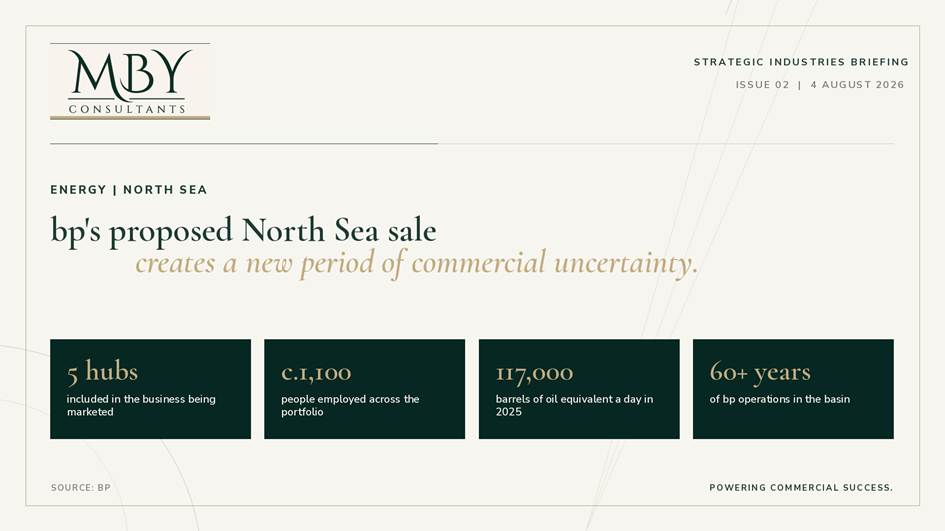
bp has launched a process to market its UK North Sea business for potential sale after more than 60 years in the basin.
The portfolio includes five production hubs, produced around 117,000 barrels of oil equivalent a day in 2025 and employs approximately 1,100 people. bp has said that it will continue to operate the assets safely and reliably while the sale process progresses.
OUR VIEW
A change of owner does not remove the obligations surrounding the assets. It can, however, change the commercial environment in which those obligations are delivered.
Capital priorities, procurement routes, contracting terms, approval processes and supplier relationships may all evolve under new ownership.
For SMEs dependent on North Sea customers, this is a prompt to assess exposure before decisions reach them. Which contracts and cash flows depend on one operator or asset cluster? Which relationships are portable? Which capabilities can serve adjacent customers or markets?
Diversification is not about abandoning the North Sea. It is about reducing the risk that one buyer's portfolio decision becomes another business's crisis.

Ofgem has opened a consultation on proposals intended to remove speculative data-centre projects from Britain's electricity connections queue. Contracted demand offers increased from 41GW to 125GW between November 2024 and June 2025.
Under the proposals, large data-centre developments would provide financial security of between £237,500 and £712,500 per megawatt when accepting a connection offer. The commitment would be returned when the project reaches energisation and could be forfeited if it leaves the queue early. Developers would also have to demonstrate progress through evidence including financial capability, commercial maturity and procurement activity.
OUR VIEW
This is more than queue management. Ofgem is proposing to make commercial maturity visible and financially consequential. A connection application can carry the appearance of progress long before a project is genuinely ready to proceed. By linking access to financial security, milestones and evidence, the system is testing whether a proposal is sufficiently real to justify reserving scarce capacity.
For developers, readiness will mean more than a viable technical concept. It will require aligned capital, planning, procurement, governance and a credible route through each delivery milestone. For the wider system, better evidence should improve network planning. That benefit will depend on transparent criteria, consistent decisions and a process able to distinguish genuine uncertainty from weak commitment.
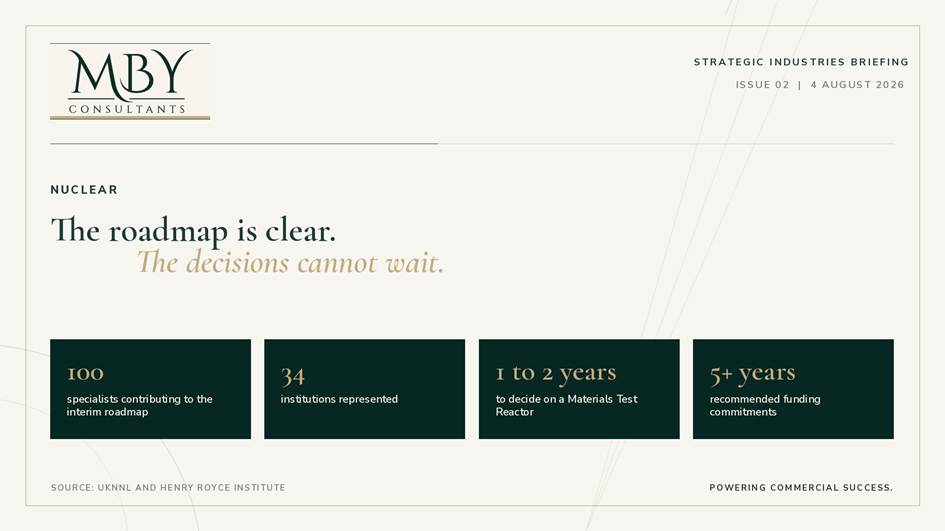
The United Kingdom National Nuclear Laboratory and the Henry Royce Institute have published an interim roadmap for UK fission materials research and development. More than 100 specialists from 34 institutions contributed. The report calls for clearer guidance on preferred reactor concepts, a decision within one to two years on whether the UK should build a domestic Materials Test Reactor, a National Materials Archive within five years and funding commitments of at least five years for sustained research programmes. The full roadmap is expected later in 2026.
OUR VIEW
Agreement on priorities is only the first stage. Capability will depend on whether each priority has an accountable owner, a funded programme, defined interfaces and a route from research through qualification to deployment.
Nuclear materials capability is particularly vulnerable to short funding cycles and fragmented demand. Expertise, facilities and irreplaceable samples take years to build and cannot be recreated quickly after they have dispersed. Sovereign capability is not simply knowledge held somewhere in the system. It is knowledge that remains funded, qualified, connected to programmes and available when the country needs it.
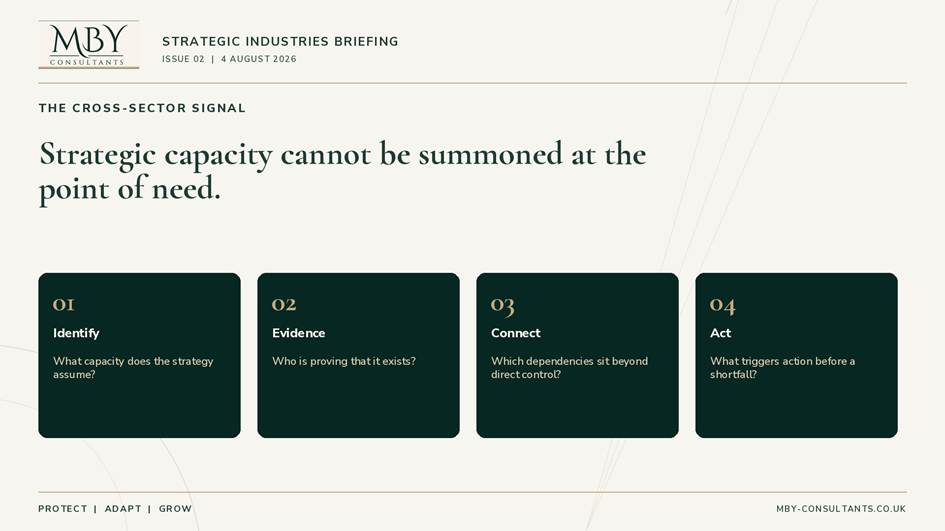
- Water infrastructure cannot be commissioned when drought is declared.
- Grid capacity cannot be reserved indefinitely by proposals that cannot prove they will proceed.
- Defence suppliers cannot scale complex delivery the moment a contract arrives.
- Nuclear materials expertise cannot be rebuilt after it has dispersed.
- North Sea suppliers cannot diversify on the day a major customer's strategy changes.
This week's news points to one commercial principle: if future delivery depends on a capability, that capability must be identified, evidenced and protected before pressure peaks.
WHAT WE ARE WATCHING NEXT
- The buyer, scope and transition arrangements emerging from bp's North Sea sale process.
- Industry responses to Ofgem's consultation before it closes on 16 September.
- How Dreadnought investment and performance incentives flow into smaller suppliers.
- Whether current drought conditions accelerate leakage reduction and the reservoir programme.
- How the final Fission Materials Roadmap converts national priorities into funded delivery programmes.
ABOUT MBY CONSULTANTS
MBY Consultants provides independent senior commercial judgement for complex programmes across energy, nuclear, defence, infrastructure and advanced industry.
We help organisations diagnose commercial exposure, focus action, embed sustainable delivery and strengthen the capability needed for growth.
PROTECT | ADAPT | GROW