
Reindustrialisation needs an order book
Strategic Industries Briefing
Issue 10 | 29 September 2026
The language of this week is reindustrialisation.
At the Labour Party Conference, the government has placed British jobs, domestic procurement and industrial capability at the centre of several announcements. Three floating docks for the Royal Navy's submarine service will be procured through a UK-only competition. Utility companies will be expected to use procurement to support British jobs and apprenticeships. The National Shipbuilding Office will gain oversight of future civil ship procurement. UK Export Finance has announced a new pilot intended to help overseas buyers purchase British goods and services.
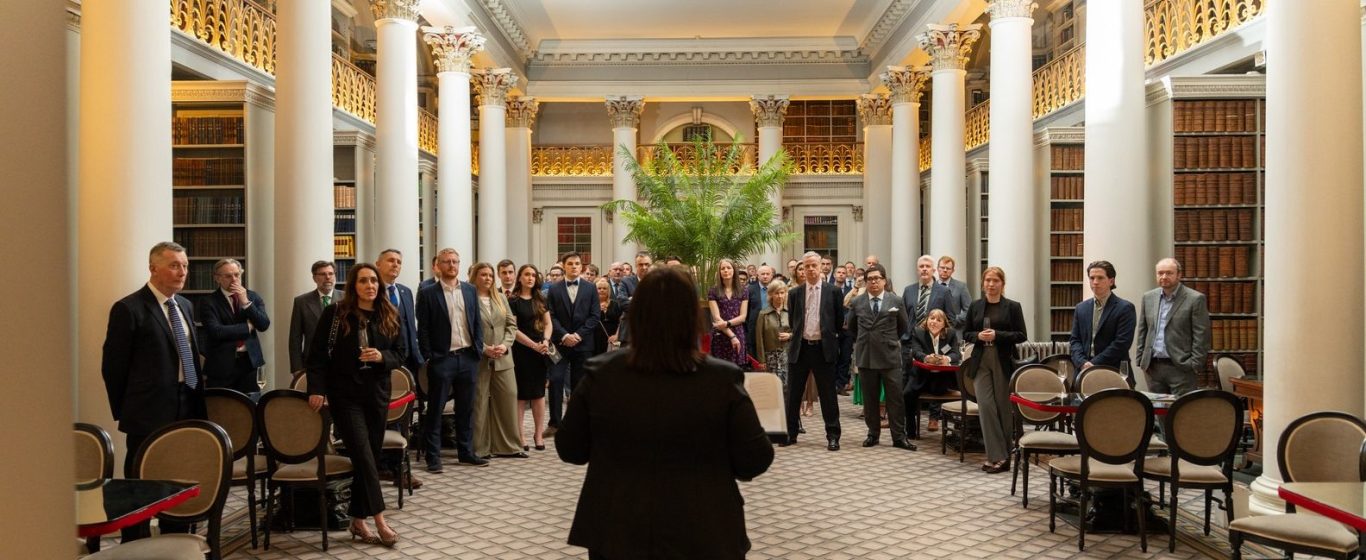
These are meaningful signals but they are not yet the order book. Last week, MBY Consultants sponsored the ADS Scotland Skills Summit at Fife College. Our Founder and Managing Director, Mariana Bergel Yarnold CMgr FCMI, spoke about a decision that employers, educators and individuals must make before work is awarded: whether the future opportunity is credible enough to justify committing now.
Reindustrialisation will not be delivered by the scale of an announcement. It will be delivered when organisations can see enough about future work, its timing, volume, standards, procurement route, commercial terms and continuity, to make a responsible investment decision.
Avanti has a transfer date but delivery still needs a mobilisation plan
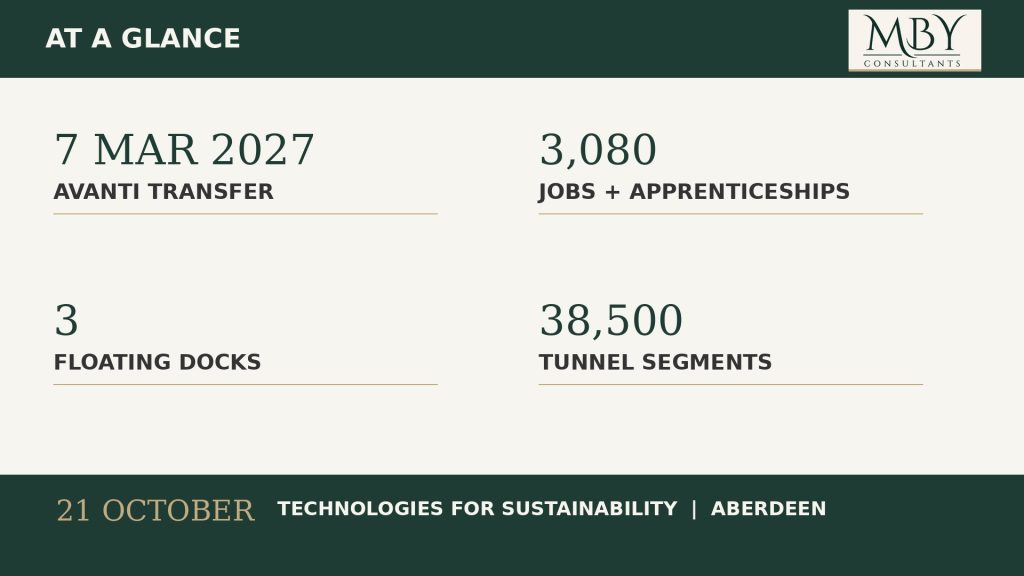
The UK Government has confirmed that Avanti West Coast services will transfer into public ownership on the 7th March 2027, when the current contract expires. The announcement is accompanied by a dedicated improvement plan. It includes an additional £10 million for power and signalling maintenance by the end of 2027, alongside an existing £840 million infrastructure programme. A further £50 million is planned for improvements at Euston over three years, with £10 million for other West Coast Main Line stations. Timetable changes are expected to begin in December 2026.
The stated objective is to bring track and train closer together ahead of Great British Railways and reduce the fragmentation that has contributed to poor performance.
OUR VIEW
Changing ownership changes accountability but it does not automatically change operational performance. The transfer must be treated as a complex mobilisation. The incoming organisation needs a clear baseline, defined decision rights, an integrated improvement programme and visible ownership of the interfaces between rolling stock, stations, signalling, power, timetabling and passenger information.
Public ownership will be judged by what changes for passengers, not by the legal form of the operator. The date is now clear. The next requirement is a delivery model capable of turning the date into improved performance.
Utility investment is being asked to create British jobs
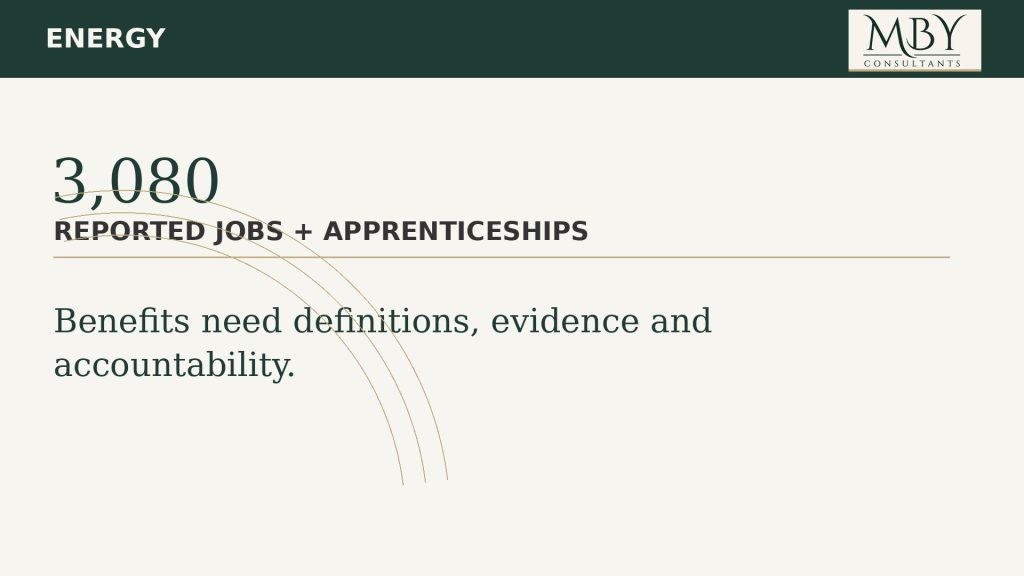
The government has announced that electricity, gas and water infrastructure providers will be expected to use procurement to support British jobs, apprenticeships and manufacturing skills as they invest in future networks. It has said legislation may follow if companies do not act voluntarily.
That expectation could be commercially significant. Regulated network investment offers something many emerging markets cannot yet provide: long-duration demand capable of supporting facilities, equipment, training and workforce development.
Recent Project Gigabit data shows both the potential and the measurement challenge. Suppliers reported 2,630 direct and indirect recruits and 450 apprenticeships between August 2022 and July 2026. However, the figures are supplier-reported, do not distinguish between permanent and temporary roles, and do not mean the employment was created in the same region as the associated contract.
OUR VIEW
Jobs and skills commitments become credible when they are designed into procurement and governed through delivery. That requires clear definitions. Is a role additional? Where is it located? How long will it last? Which supply-chain tier created it? What evidence will be required? What happens if the commitment is not delivered?
If these questions remain unanswered, social value becomes a headline attached to expenditure. If they are resolved early, network investment can create a dependable demand signal that enables suppliers and training providers to invest with greater confidence.
Three floating docks create a sovereign procurement test
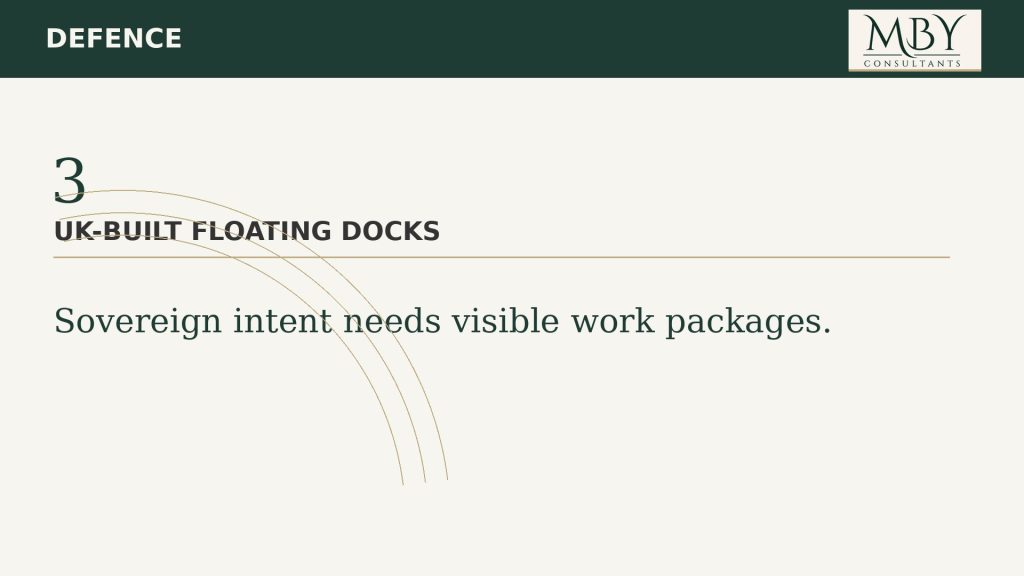
The government has confirmed that three new floating docks for the Royal Navy's submarine service at HM Naval Base Clyde will be built in Britain through a UK-only competition. Known as Programme Euston, the facilities will support inspections, upgrades and repairs across the current and future nuclear-submarine fleet. The commitment sits within a wider package of maritime investment intended to support national security, British shipbuilding and a pipeline of work for smaller businesses.
The domestic competition provides a clear signal about sovereign intent. It establishes that the capability must be retained in the UK and that British industry will have a defined route into the procurement.
OUR VIEW
The UK-only commitment is important, but nationality does not make a procurement accessible. Shipyards, engineering businesses and specialist SMEs still need to understand the competition timetable, packaging strategy, qualification requirements, technical interfaces and expected production sequence. They also need proportionate commercial terms that allow them to invest without accepting risks they cannot control.
Programme Euston can become a genuine industrial-capacity programme. That will depend on how quickly the political commitment becomes a visible and investable order book for the businesses expected to deliver it.
Sizewell C translates continuity into manufacturing demand
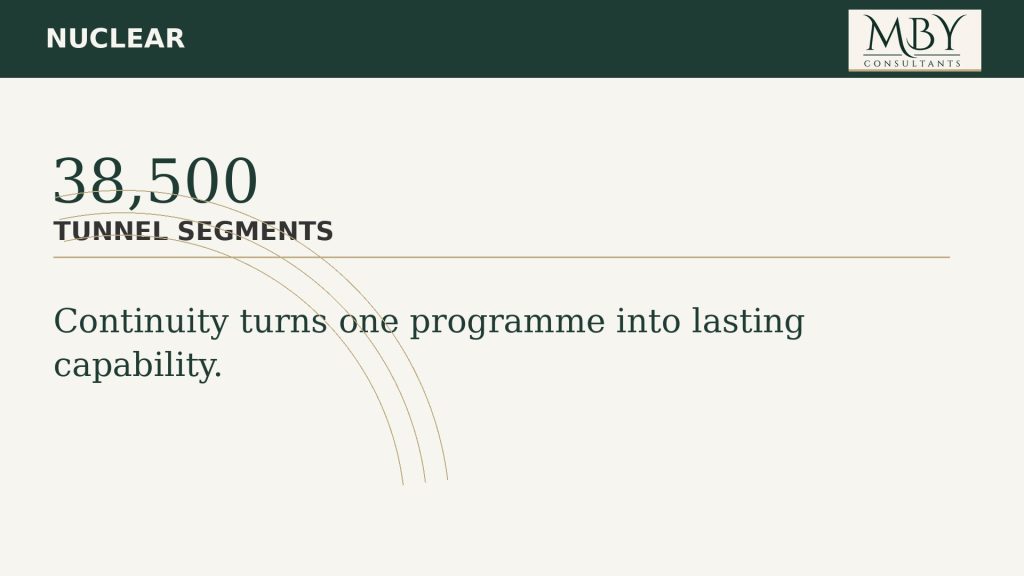
Sizewell C has secured planning permission for an Avonmouth production facility that will manufacture the pre-cast concrete components required for its marine tunnels. The facility is expected to support up to 400 jobs. It will manufacture 38,500 tunnel segments for three tunnels, with production expected to begin in 2028. Components will then be transported to Suffolk by rail and sea.
The site previously supported Hinkley Point C. Sizewell C intends to reuse the infrastructure, experience and manufacturing knowledge created by that programme. Early work already supports 55 people employed by the delivery partner and 86 supply-chain workers.
OUR VIEW
This is how an industrial strategy begins to become commercially credible. There is a defined product, a known quantity, a location, an expected production date and a direct connection to a funded programme. Reusing the Hinkley Point C facility and workforce also provides continuity between projects rather than allowing specialist capability to disappear between awards.
The next test is how the 38,500-segment requirement flows into supply-chain packages, apprenticeships and sustained capability after the final component is produced. One facility can create employment. A sequence of visible programmes creates an industry.
The decision comes before the contract
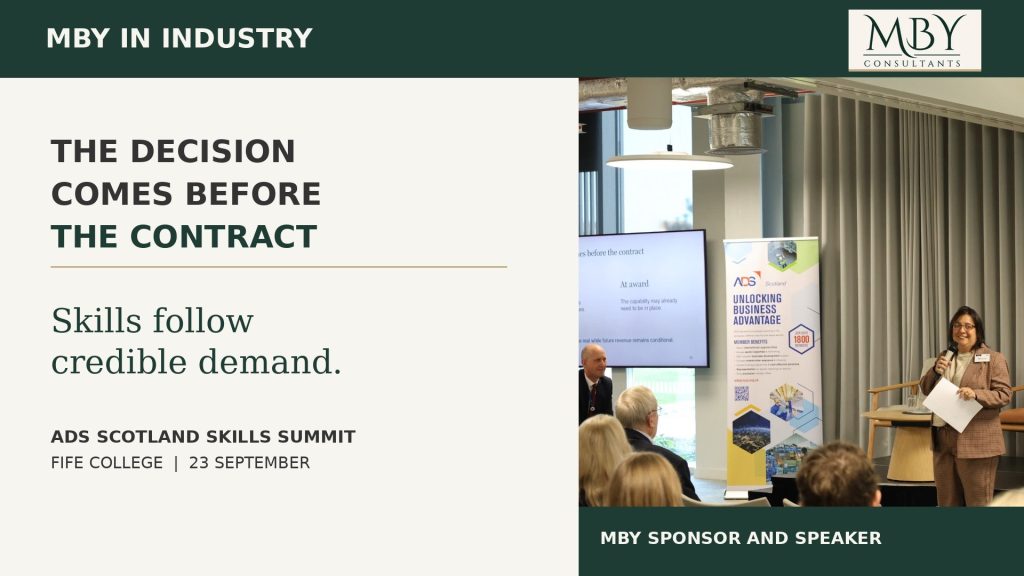
Last week, MBY Consultants sponsored the ADS Scotland Skills Summit at Fife College, where our Founder and Managing Director, Mariana Yarnold, spoke about strengthening capacity across the supply chain.
The central argument was simple: by the time a contract is awarded, the required capability may already need to exist. Businesses must decide whether to invest in people, systems, accreditations and facilities while future revenue remains conditional. Colleges must decide whether expected demand justifies committing teaching capacity and specialist resources. Individuals must decide whether training for a new role offers the prospect of a lasting career.
For SMEs, waiting for certainty can leave them unprepared when work arrives. Investing too early can expose the business, its capital and its existing workforce. The answer is not to promise certainty where none exists. It is to provide clearer and earlier signals about likely work, timing, standards, procurement routes and continuity. That principle applies well beyond the sectors represented at the Summit. Skills follow credible demand.
Why Aberdeen and why now
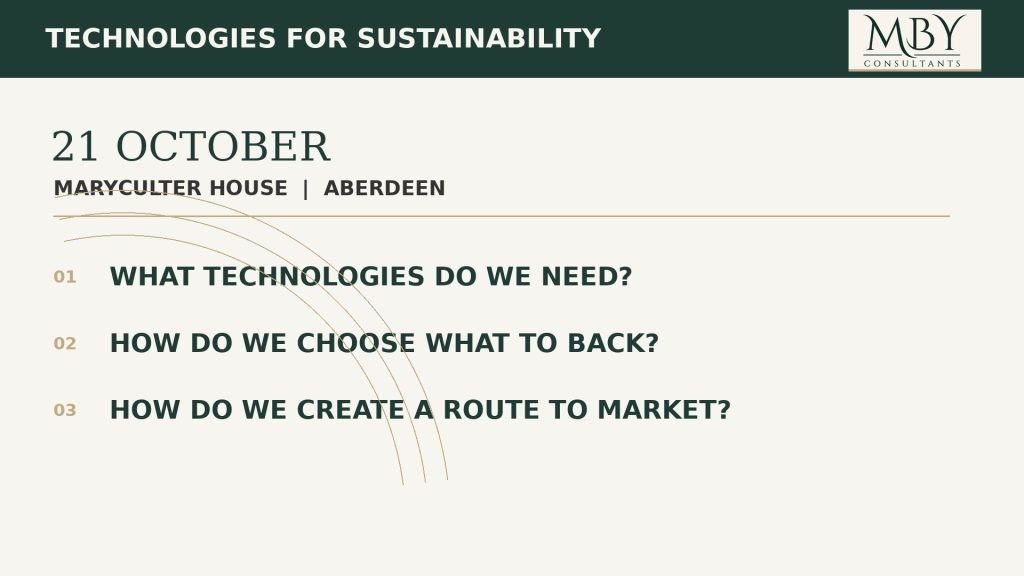
"TECHNOLOGIES FOR SUSTAINABILITY"│ ABERDEEN 2026 │ IV ENTREPRENEURS AND INVESTORS ROUNDTABLE comes to Maryculter House, on the 21st October.
The Roundtable is deliberately question-led rather than sector-led. It will examine which technologies industry needs, how organisations decide what to back, why promising solutions struggle to move beyond demonstration and what turns technical potential into repeat customers and durable markets.
This week's launch of a UK Export Finance pilot worth up to £5 billion reinforces that the route to market is not only technical. Overseas buyers, finance, standards, commercial partnerships and delivery capability must connect before British technology becomes an export order.
Aberdeen already has deep engineering, offshore, maritime, asset-integrity and programme-delivery capability. The question is how that capability is connected to the technologies, investment and markets that will shape what comes next. That is why MBY Consultants helped bring this conversation to Aberdeen now. We explain the reasoning in our article, Why Aberdeen and why now.
21 October 2026 | Maryculter House, Aberdeen | Places are limited and filling quickly.
The promise is not the order book
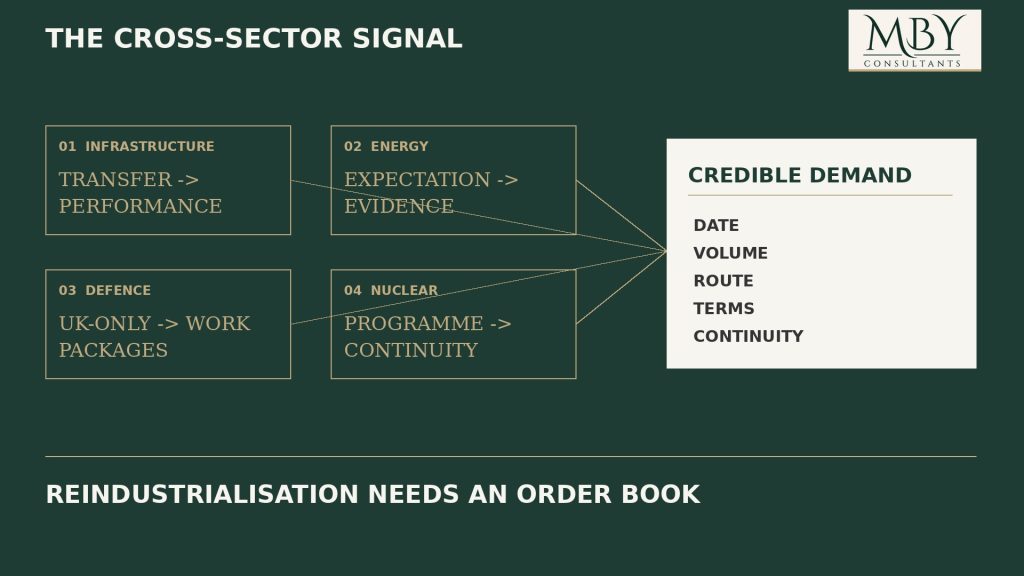
This week's stories sit at different points on the route from political commitment to deliverable work.
Avanti has a transfer date and an improvement programme, but the operating interfaces must still be mobilised. Utilities have been given an expectation to create jobs and apprenticeships, but the definitions and accountability mechanisms must still be designed. Programme Euston has a sovereign UK procurement route, but suppliers still need packages, dates and qualification requirements. Sizewell C's Avonmouth facility has progressed further: it has a defined output, quantity, location and production horizon.
Credibility increases as an announcement acquires a date, a volume, a route to contract, workable commercial terms and continuity beyond the first award. An order book is not a spreadsheet of hypothetical value. It is a sufficiently credible sequence of executable work against which organisations can govern investment.
If Britain wants businesses to recruit, colleges to train and individuals to commit to strategic careers, the route from ambition to work must become visible earlier.
Reindustrialisation needs an order book.
What We Are Watching Next
- The Avanti mobilisation plan and the performance baseline against which public ownership will be judged.
- How utility job and apprenticeship expectations become regulatory, procurement and contractual obligations.
- The Programme Euston competition timetable, work-package strategy and access for specialist SMEs.
- The route from Sizewell C's 38,500-segment requirement into supplier contracts and durable regional capability.
- Whether UK Export Finance's Flexible Finance pilot creates accessible export opportunities for British SMEs.
- The cross-sector deployment conversations being brought together at "TECHNOLOGIES FOR SUSTAINABILITY"│ ABERDEEN 2026 │ IV ENTREPRENEURS AND INVESTORS ROUNDTABLE on the 21st October.
About MBY Consultants
MBY Consultants helps organisations design and strengthen the commercial architecture needed to deliver complex programmes. We work across strategic industries to connect governance, contracts, controls, supply chains and decision-making, leaving stronger capability inside client teams.