

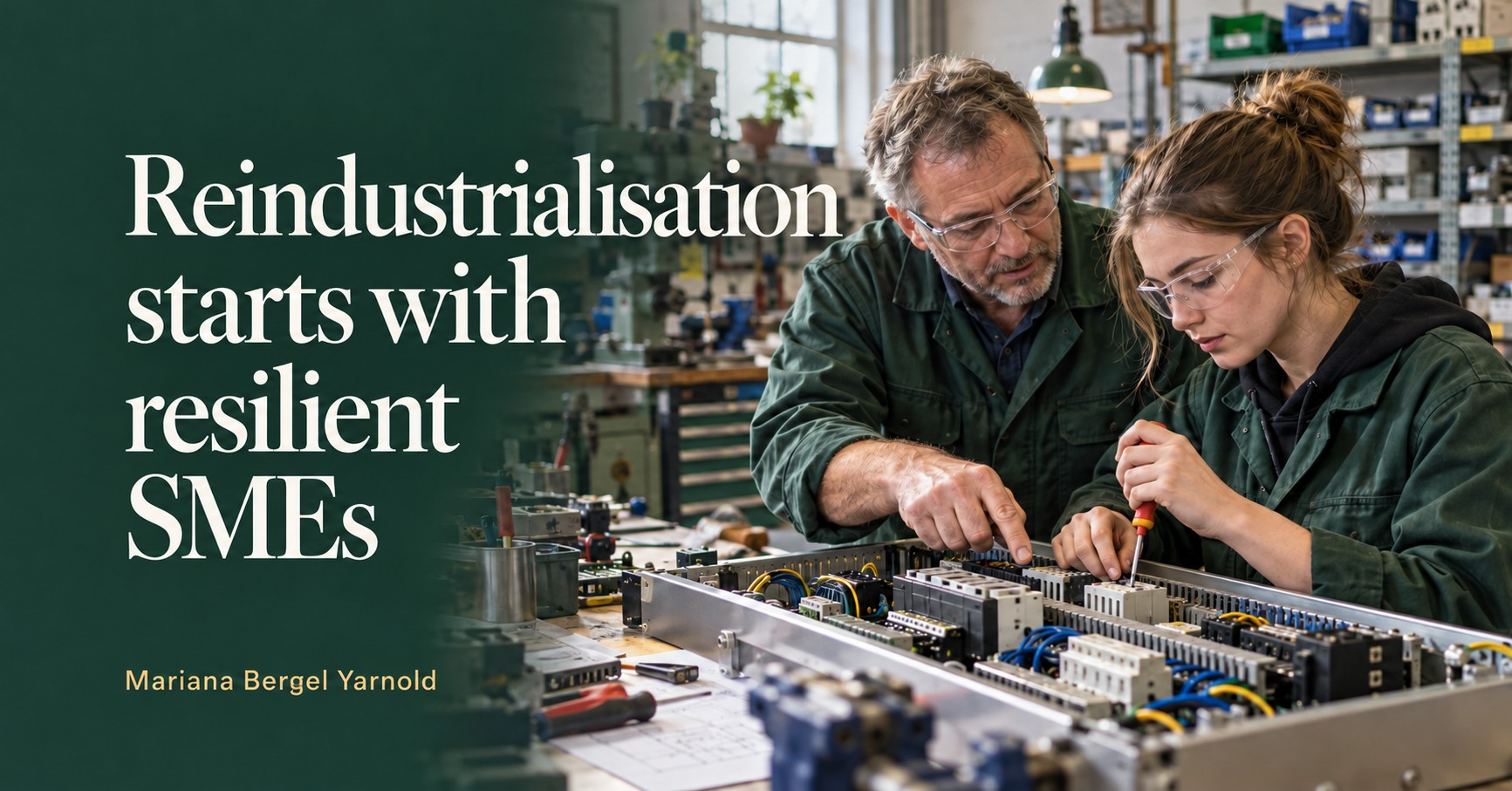
Reindustrialisation starts with resilient SMEs
Building supply chain confidence, investing in skills and sharing risk for lasting industrial growth
I seem to be having the same conversation in every sector. How do we unlock capacity in the supply chain, make SMEs more resilient and give them the confidence to invest in skills through apprenticeships?
Industrial ambition depends on SME capacity
The government’s ambition for reindustrialisation makes that conversation more urgent. Its own industrial strategy presents clean energy as a major opportunity to rebuild industrial capacity. Across the wider economy, delivering that ambition will depend on the smaller businesses that manufacture components, provide specialist services and hold much of the practical knowledge needed to turn investment into working assets. SMEs have to be at the heart of the strategy from the beginning.
Industry colleagues are warning me about shortages in essential roles, including electrical and electronic technicians, and about the gap they expect by 2030. That is close enough to affect decisions about apprentices being recruited now. Waiting until projects are ready to mobilise before addressing the skills needed to deliver them leaves very little room to recover.
The pressure also extends across sectors. Defence, offshore wind, oil and gas, nuclear energy and construction compete for the same pool of skilled workers, including electrical technicians. Moving experienced people between employers may fill an immediate vacancy, but it does not increase the overall supply of skills.
Skills investment needs commercial confidence
For an SME, taking on an apprentice is a commitment that continues regardless of whether a customer’s investment decision arrives on time. This is where the conversations about skills and supply chain resilience meet. A supplier may understand the opportunity ahead and want to prepare for it, while having insufficient confidence in the timing of orders to justify another person on the payroll. An announcement of future investment does not, on its own, give that business the means to fund training.
We need to take that hesitation seriously. A small business asked to maintain capacity through repeated delays may eventually have to reduce it. Once an experienced supervisor leaves, the consequences extend beyond the loss of their own productive hours: the business may also lose its ability to train the next person. Recovering that capability can take much longer than restarting procurement.
Shared risk across the supply chain
Building a resilient supply chain therefore requires attention to the businesses furthest from the main investment decision, where its consequences can be hardest to absorb. If a major programme depends on specialist SMEs several tiers down, the people responsible for that programme need to understand what those firms require to remain capable of delivering. Larger customers can help through earlier engagement and procurement that gives suppliers a credible basis for planning. Prompt payment is fundamental to this conversation, as is paying for necessary preparatory work rather than assuming that suppliers can carry it indefinitely. Where a customer needs capacity reserved ahead of a final decision, the commercial arrangement should address the cost of that commitment and what happens if the timetable moves.
Some uncertainty will always remain. The question is how it is managed between the parties, particularly where the supplier has little influence over the decision causing the delay. Expecting an SME to absorb unlimited postponement while continuing to invest in people is unlikely to produce the supply chain the customer needs.
The role of Government
Government also needs to connect industrial ambition with the practical conditions for training. Apprenticeship support should take into account the employer’s costs beyond tuition, while colleges and training providers need sufficient visibility of demand to prepare their own staff and facilities. In Scotland, that requires coordination between UK investment plans and the Scottish skills system. The businesses expected to deliver the work should be involved in shaping those decisions.
SMEs role: building internal resilience
SMEs have responsibilities of their own. They need systems and processes that allow them to understand their exposure early enough to act, particularly when a large part of their future income depends on a few customers or projects. That means knowing which work is contracted, which remains an opportunity and what a delay would do to cash available for wages and training. That understanding has to reach beyond the order book. A business needs to know whether its prices cover the real cost of delivery, including supervision, and whether changes to the work are being recorded and paid for. It needs a realistic view of the commitments it can sustain if an expected order moves by several months. Without that visibility, decisions about apprenticeships can become dependent on hope rather than an affordable plan.
The processes should be proportionate to the business. Clear responsibilities and reliable information help an owner decide when to recruit and which commitments can reasonably be accepted. Better planning and less rework can also free experienced people to spend time training others. Capturing their knowledge reduces dependence on a few individuals and helps apprentices develop within a consistent way of working.
Better control cannot make an indefinite delay affordable. It can, however, give an SME more options before the situation becomes critical. Those might include phasing recruitment, agreeing funded early work or finding complementary demand in another market. Diversification needs preparation too, because the qualifications and assurance requirements of another sector may take time to meet.
Coordinate training before capacity is lost
There is scope for cooperation between SMEs, larger employers and training providers. Shared training facilities or coordinated placements could help smaller firms offer opportunities they would struggle to sustain alone, provided responsibility for the apprentice and the quality of their training remain clear. Such arrangements need to be planned before a host business runs out of work.
Turn ambition into practical commitments
I would like to see the discussion move towards these practical commitments. Which capabilities will be needed, when do people need to begin training, and who will support the businesses carrying that cost before the main investment starts? Those questions belong in investment and procurement decisions.
A credible reindustrialisation strategy should make it possible for a capable small business to invest in its next generation of skilled people and remain viable while doing so. That is how industrial capacity grows across a supply chain, and how more young people gain access to a lasting career.
If reindustrialisation is the destination, SMEs are at the heart of how we get there. The conditions in which they are expected to operate must reflect the importance of the work we are asking them to do.