
Who carries the cost of strategic ambition?
STRATEGIC INDUSTRIES BRIEFING
Issue 04 | 18 August 2026
The UK's strategic industries are not short of ambition. The harder question is how the cost, risk and responsibility of delivering that ambition are shared.
This week, Ofwat has provisionally approved further water-sector investment that could raise bills. Rosebank and Jackdaw remain under review while their supply chains wait for certainty, and Ofgem is considering which long-duration electricity-storage projects should receive support. A defence autonomy competition moves from outline ideas to full proposals, and the Government's consultation on a planning framework for fusion has closed.
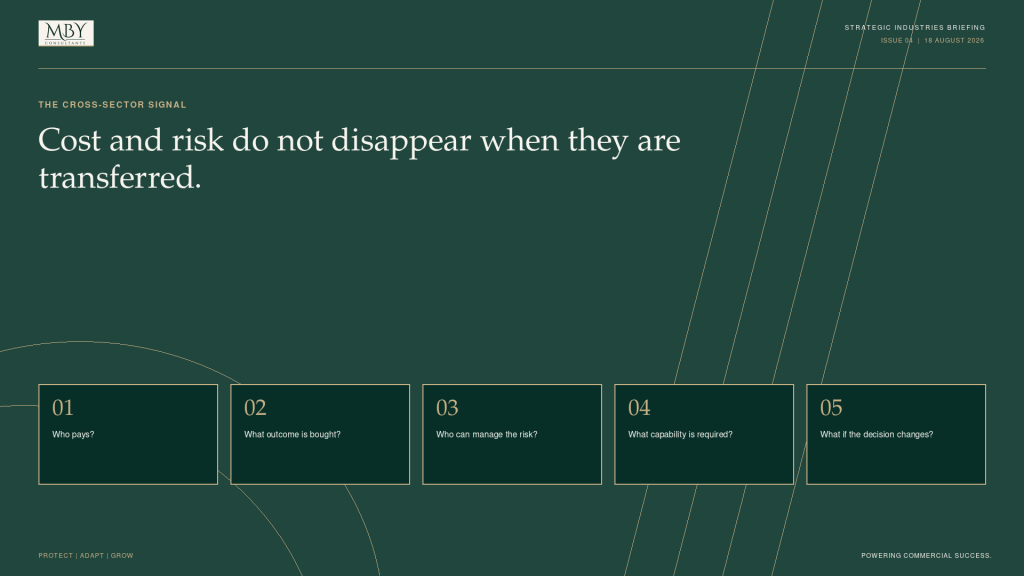
Each development is different. Together, they expose the same commercial test: whether the organisations making commitments have been clear about who pays, what outcomes will be delivered and who is best placed to manage the risk.
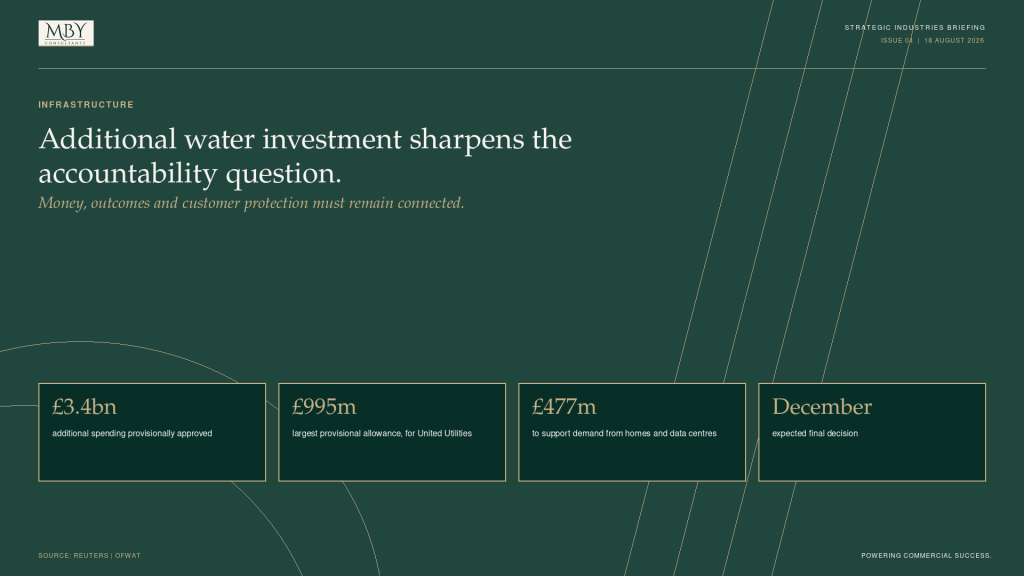
Ofwat has provisionally approved up to £3.4 billion of additional spending through its cost change process. Five water companies would be able to recover part of that expenditure through higher customer bills between 2027 and 2030. United Utilities received the largest provisional allowance at £995 million, while £477 million across the programme is intended to support demand created by new housing and data centres.
The regulator says funding can be recovered if companies fail to deliver the agreed outcomes. Final decisions are expected in December.
OUR VIEW
Customers cannot be treated as an open source of risk capital. If bills rise to fund additional infrastructure, the link between money, scope and outcome must be visible. Each allowance needs a defined delivery baseline, measurable benefits, transparent progress reporting and an effective route for recovering money when commitments are missed.
The commercial question is not whether investment is needed. It is whether the delivery system protects customers while giving suppliers and operators enough certainty to perform. Accountability needs to be designed into the funding decision, not added after performance slips.
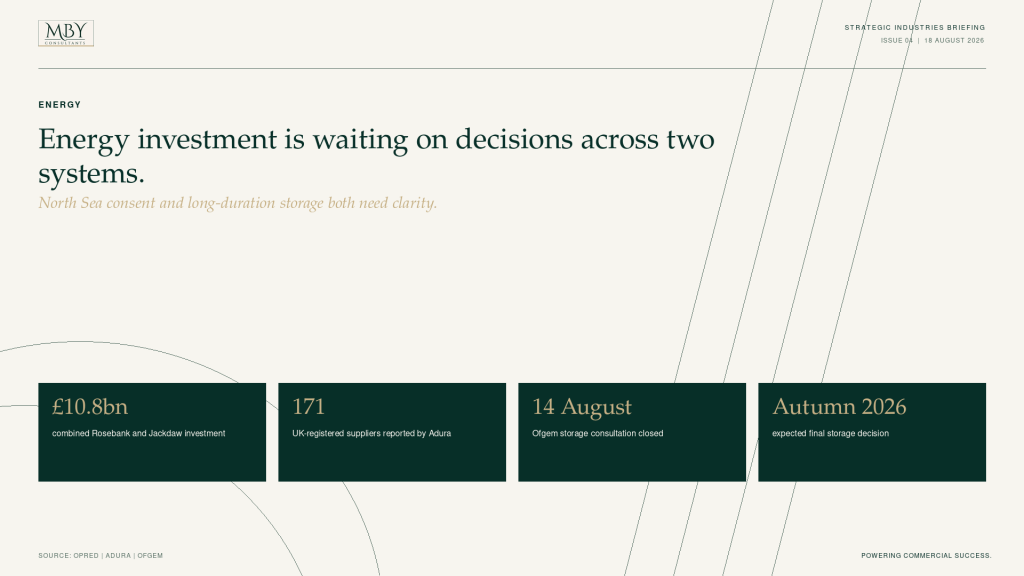
The latest public consultation on further environmental information for the Rosebank field closed on 17 August, one week after the equivalent consultation for Jackdaw closed on 10 August. Both projects remain under review by the Offshore Petroleum Regulator for Environment and Decommissioning.
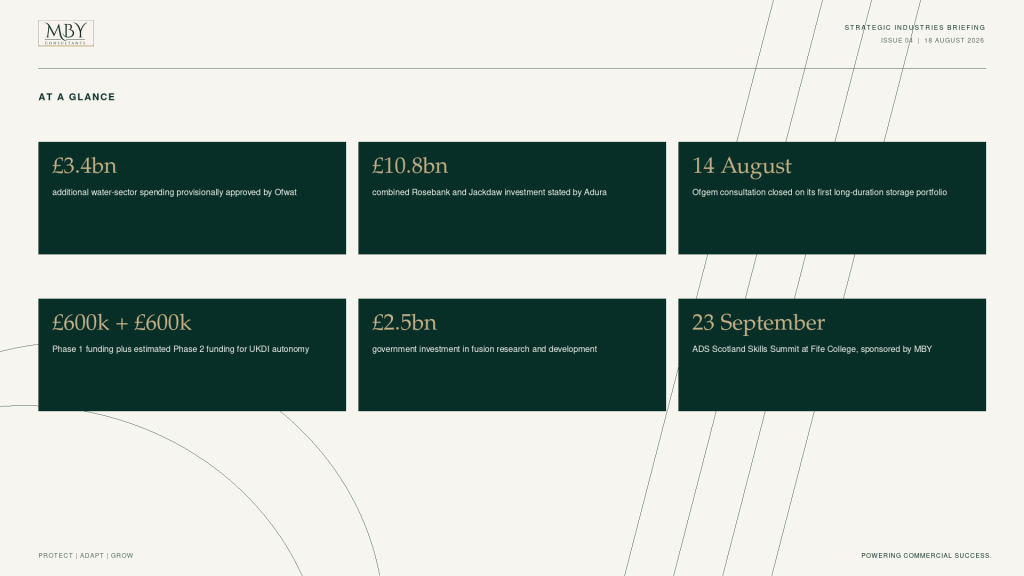
Adura estimates combined investment of £10.8 billion across Rosebank and Jackdaw, with more than £3 billion already committed. It reports that 198 supplier contracts have been placed across the two projects, including 171 with UK-registered businesses. Adura also estimates £9.1 billion of supply-chain activity and more than 3,500 jobs at peak construction. Those are developer estimates, but they indicate the scale of the commercial commitments already sitting behind the regulatory process.
Elsewhere in the energy system, Ofgem's consultation on its minded-to decisions for the first long-duration electricity-storage cap-and-floor application window closed on 14 August. The regulator is assessing the proposed project portfolio using cost, system-modelling, economic, financial and strategic criteria, with a final decision expected in autumn 2026. Long-duration storage is intended to help maintain system reliability, integrate renewable generation and reduce costs. The decision will determine which projects receive a regulated route capable of supporting investment.
OUR VIEW
These are different markets, but the commercial problem is the same: capital, suppliers and skilled people cannot remain indefinitely committed to an unresolved decision. Investment already incurred cannot override environmental scrutiny, and system need cannot replace a robust value-for-money assessment. Equally, suppliers, workers, developers, investors and communities need clear criteria, a credible timetable and a decision they can plan around.
For Rosebank and Jackdaw, uncertainty reaches ports, fabricators, manufacturers, engineering firms, vessel operators and specialist suppliers. For long-duration storage, the design of the support mechanism determines whether technically credible projects can secure investment without transferring poorly controlled cost to consumers.
Energy strategy cannot be managed one project at a time. Decisions across domestic production, storage, networks and renewable generation must form a deliverable system. Certainty does not mean approving every project. It means timely, evidence-based decisions and a credible transition path for the people and capability affected by them.

Stage 1 of UK Defence Innovation's Novel Autonomy and Robotics competition closed on 11 August. Decisions are due on 18 August, when selected applicants will be invited to submit full Stage 2 proposals. The competition provides £600,000 for Phase 1, with a maximum proposal value of £60,000, and estimates a further £600,000 for Phase 2. Projects begin at Technology Readiness Level 1 or 2, must advance by at least one level and are expected to run for no more than three months. Stage 2 closes on 15 September, with projects intended to begin in November.
OUR VIEW
The two-stage process reduces the effort required before an idea has passed an initial relevance test. That is sensible. The harder work begins when a promising concept has to become credible evidence. At low technology readiness levels, commercial discipline still matters. Intellectual property, data rights, security, test criteria, cost to mature and the route to an operational customer should be considered before the technical programme hardens.
The objective is not only to fund inventive ideas. It is to create a path by which the strongest ideas can be tested, trusted and carried into future capability.
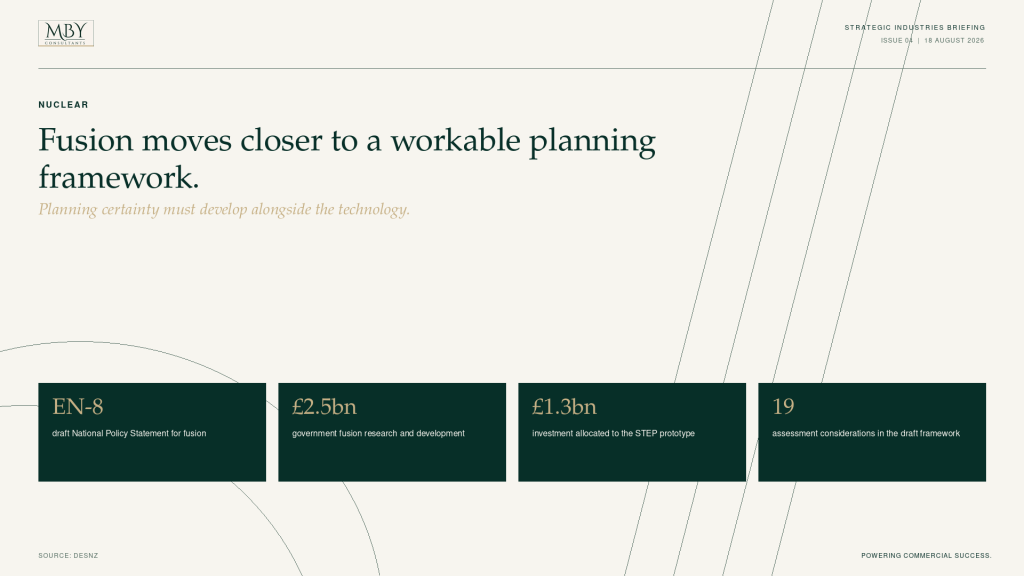
The Government's consultation on draft National Policy Statement EN-8 for fusion energy generation closed on 17 August. The proposed framework applies to England and Wales. It is designed to be technology and output agnostic and does not identify specific sites. It sets out 19 considerations across environmental, safety and security, operational and developmental themes. The consultation follows more than £2.5 billion of Government investment in fusion research and development, including £1.3 billion for the STEP prototype power plant.
OUR VIEW
A dedicated policy statement can reduce uncertainty and improve consistency, particularly as fusion moves from research towards demonstration and deployment.
Planning clarity is only one part of the delivery model. Developers will still need to coordinate regulation, land, grid, cooling, supply-chain capability, financing and community engagement around technologies that are still evolving. The framework will be most valuable if it gives decision-makers enough consistency to act without freezing innovation too early. Commercial and regulatory interfaces need to develop alongside the technology, not wait until a first project is ready to procure.

MBY Consultants is sponsoring the ADS Scotland Skills Summit at Fife College on the 23rd September 2026. Mariana Yarnold will attend on behalf of MBY.
The event brings together employers, educators, apprentices and graduates from aerospace, defence, security and space to examine Scotland's future skills needs and strengthen the talent pipeline.
For MBY, this is directly connected to delivery. Workforce capability is not a downstream human-resources issue. It shapes what can be promised, when work can begin and whether growth can be sustained. The strongest skills strategies connect long-term demand with practical routes into industry, give smaller suppliers a voice and make it easier for education providers to respond before shortages become critical.
Event details and registration: ADS Scotland Skills Summit 2026
WHAT WE ARE WATCHING NEXT
- Ofwat's final decisions in December and the measures used to hold companies to the outcomes funded by customers.
- The Rosebank and Jackdaw decisions and their effect on investment, jobs and the UK supply chain.
- Ofgem's final decision on the first long-duration electricity-storage portfolio, expected in autumn 2026.
- Which autonomy concepts enter Stage 2 and how applicants define evidence, security and a route to military use.
- How consultation responses shape EN-8 and whether the final policy improves planning certainty without constraining innovation.
- The discussion at the ADS Scotland Skills Summit and the practical commitments that follow it.
PROTECT | ADAPT | GROW